

















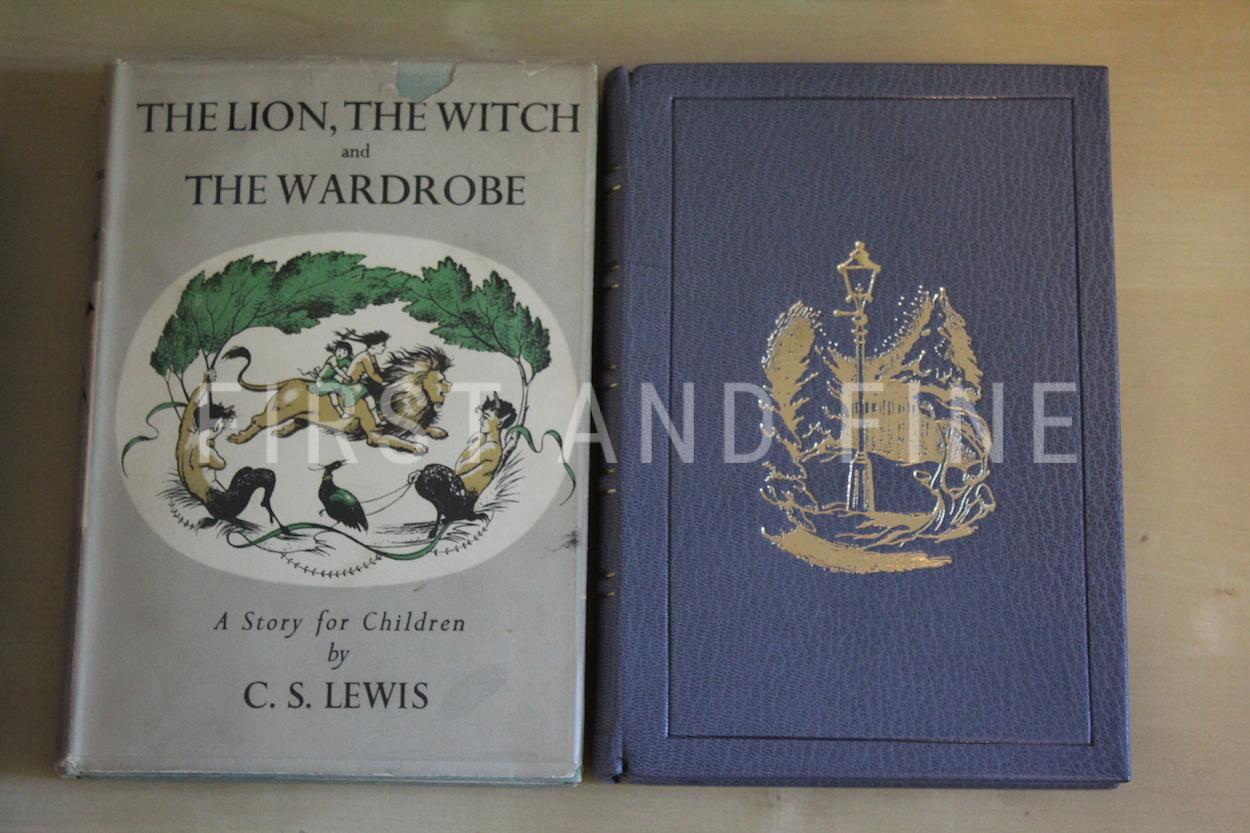
Lewis, C.S. (1950-56) ‘The Chronicles of Narnia’, UK first edition set with original handwritten and signed letter
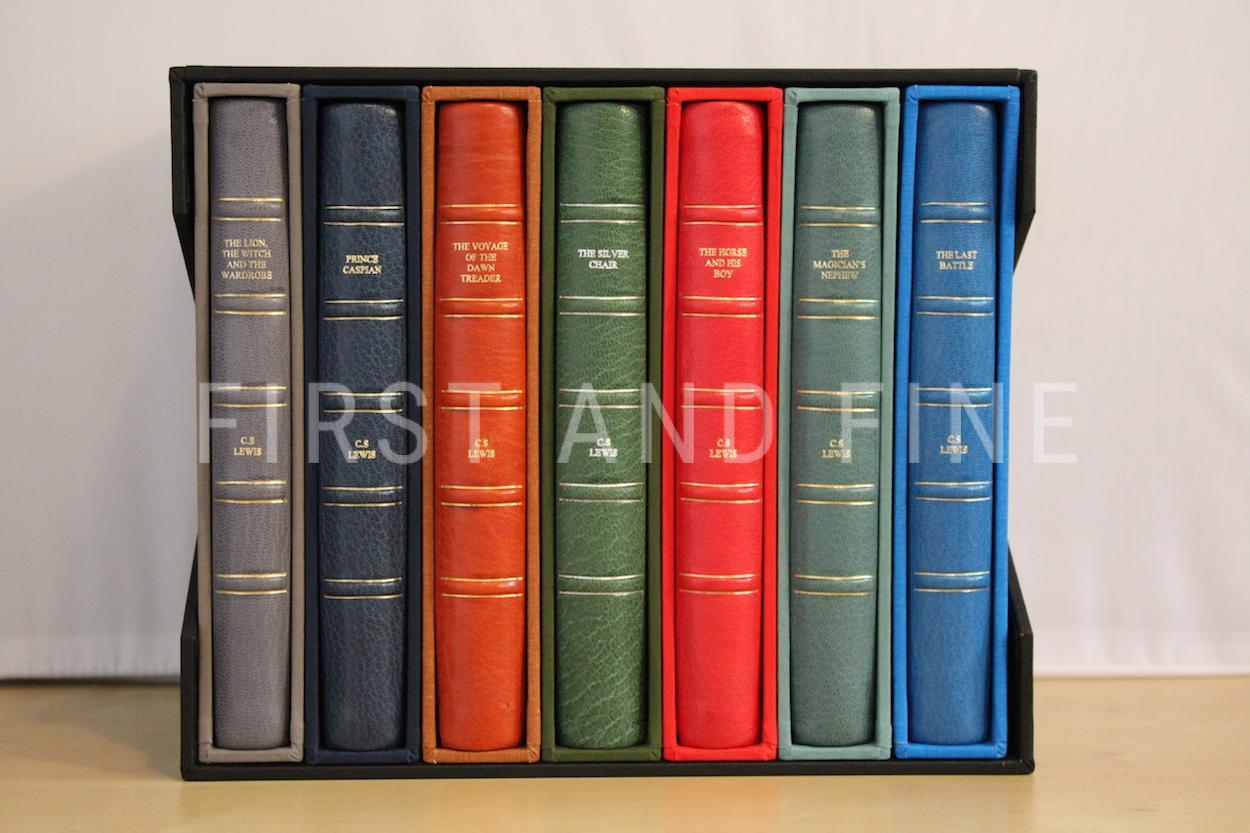
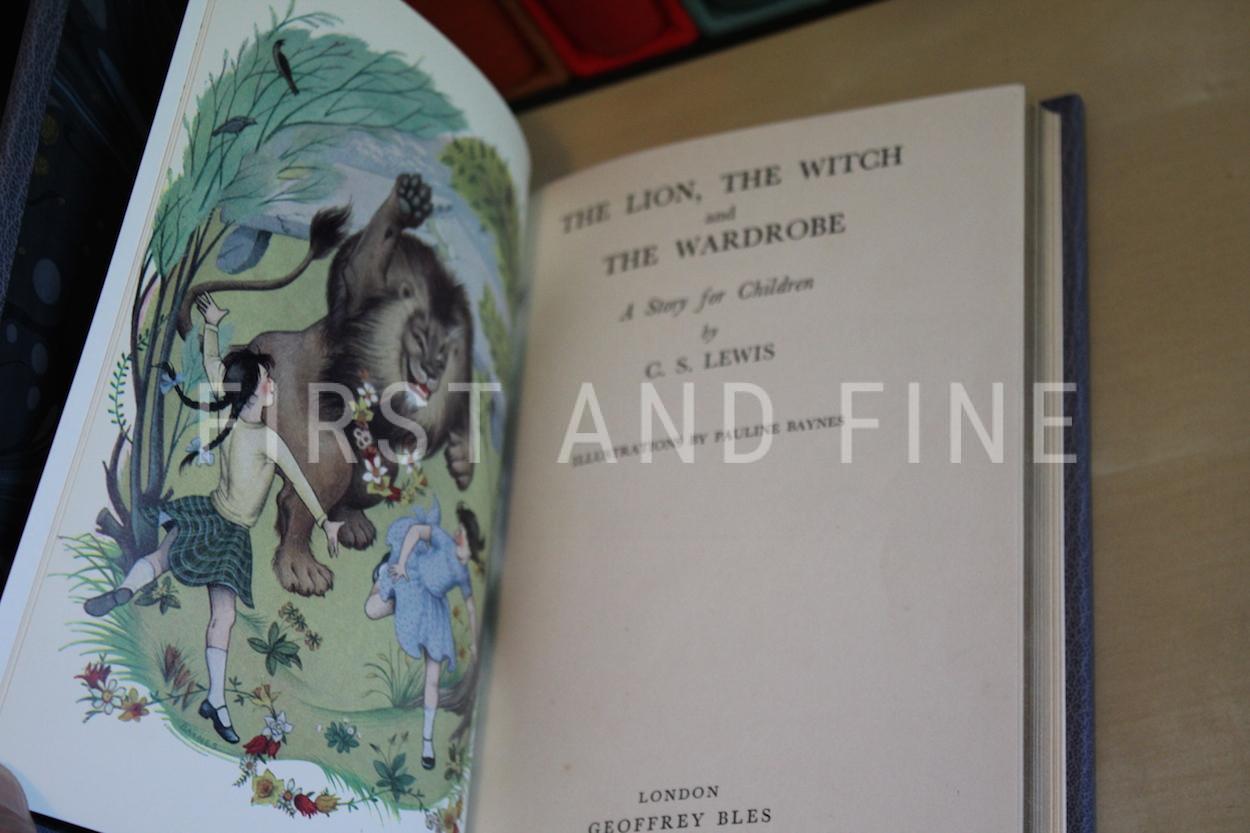
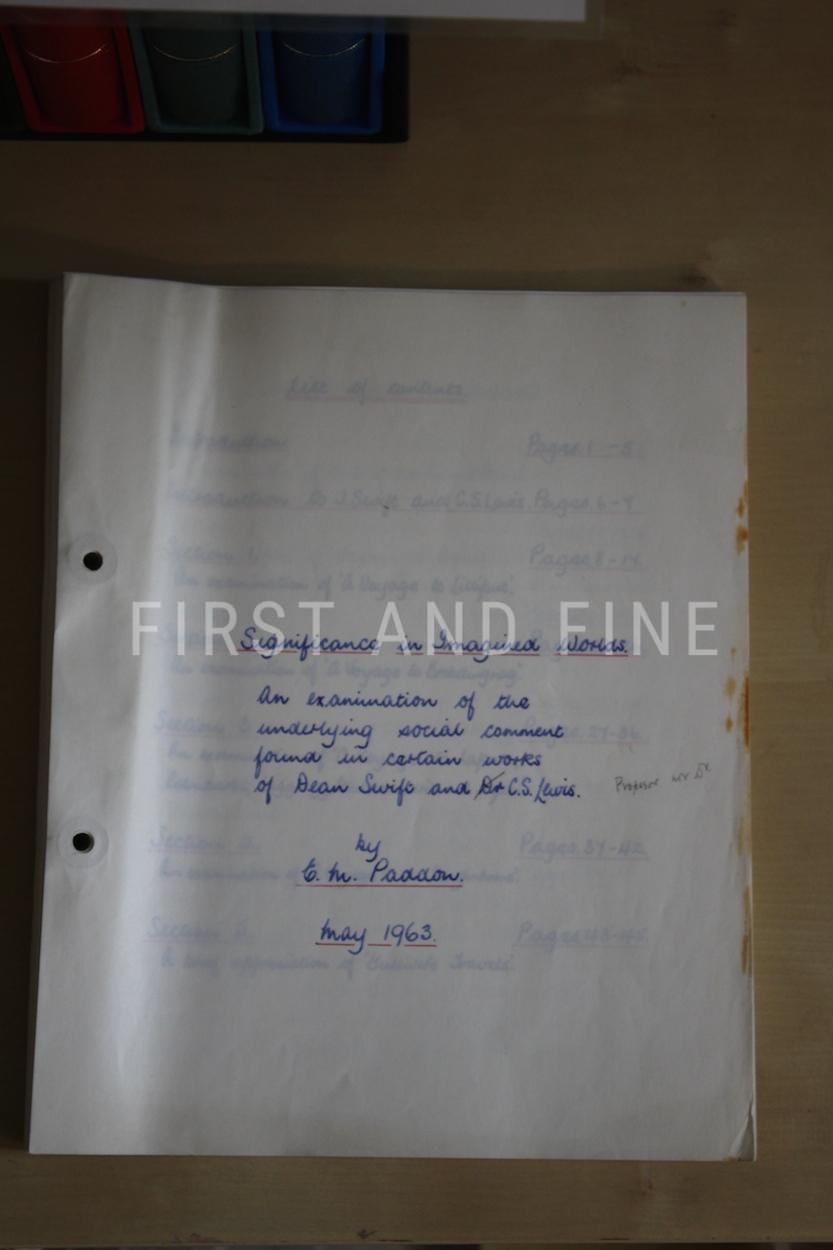
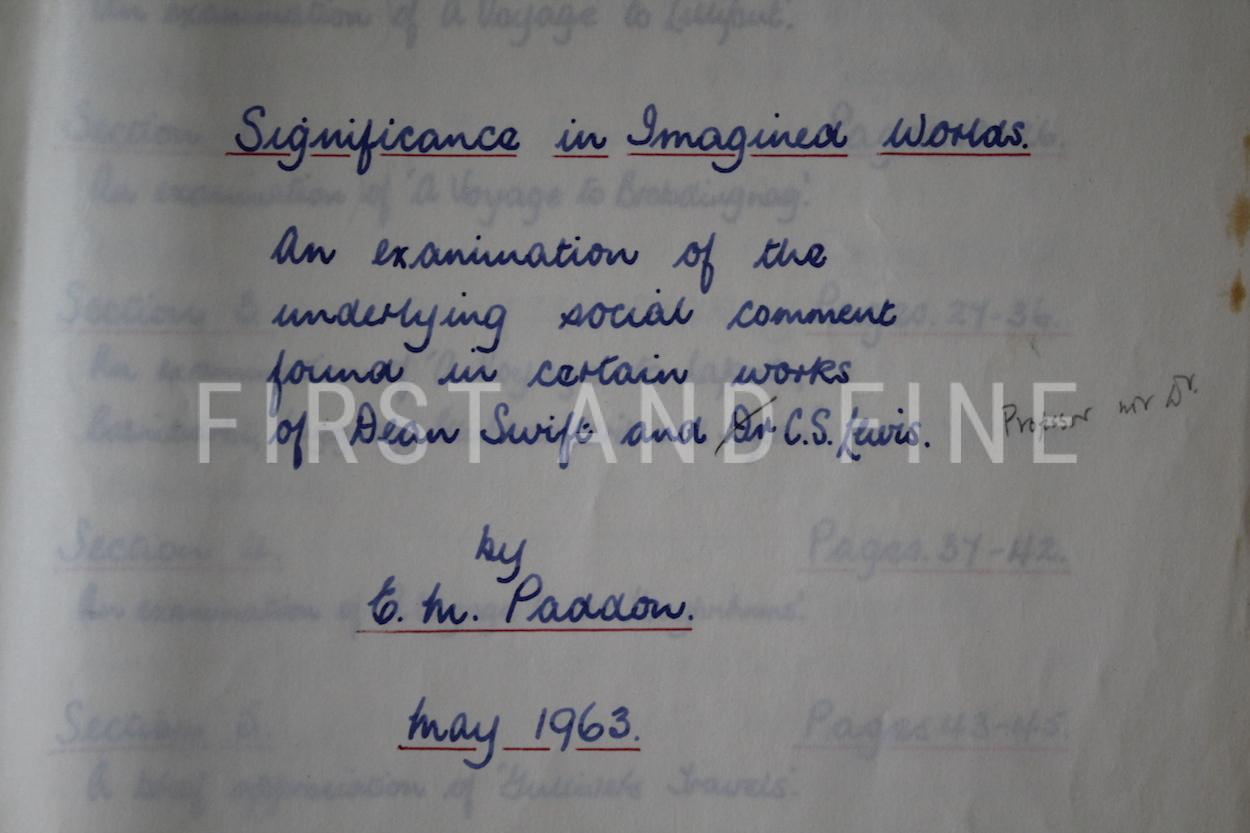
Clive Staples Lewis (1950-56) ‘The Chonicles of Narnia‘, UK first editions, first printings, published by Geoffrey Bles (first five volumes) and Bodley Head (last two volumes) as called for. Beautifully and skillfully rebound in finest goatskin leather with a design that reflects the author’s own intention (see below for details) by Richard Tong, a prize-winning bookbinder and publisher from Shropshire, UK. In addition, the set comes with an original handwritten and signed letter by C.S. Lewis on the topic of literary influences on his writing (see below); together with the thesis of a young scholar who used this very letter in her bibliography; and alongside an inscribed first edition of Michael Ward’s (2008) seminal work ‘Planet Narnia‘ which uncovers the symbolism of the Narnia Chronicles (see below) and which co-inspired our design.
Condition of the Narnia books: apart from a few occasional ageing spots, mostly confined to the first or last pages, this is a very clean set with no previous owners’ inscriptions, no scribbles, no bookplates and no stamps. The leather bindings have been custom made for us and thus present in fine condition.
Production details of the Narnia books:
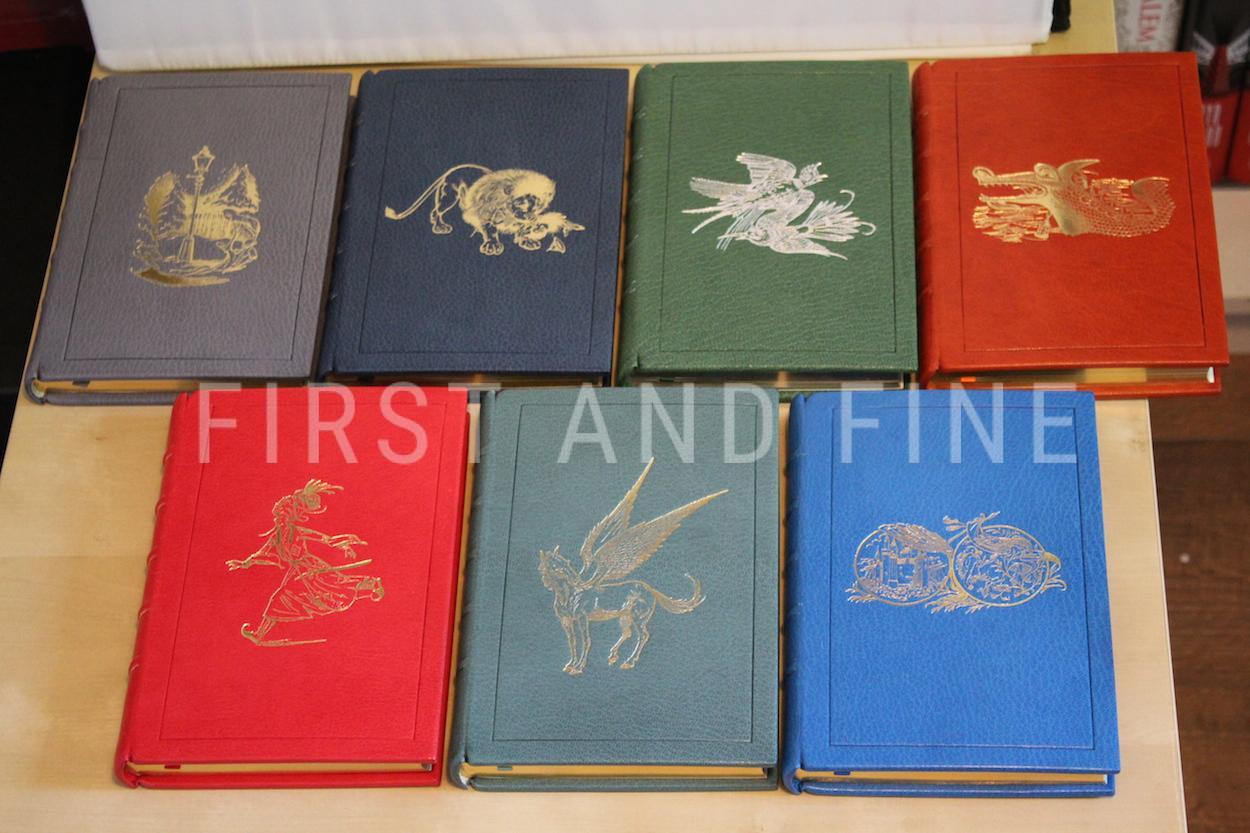
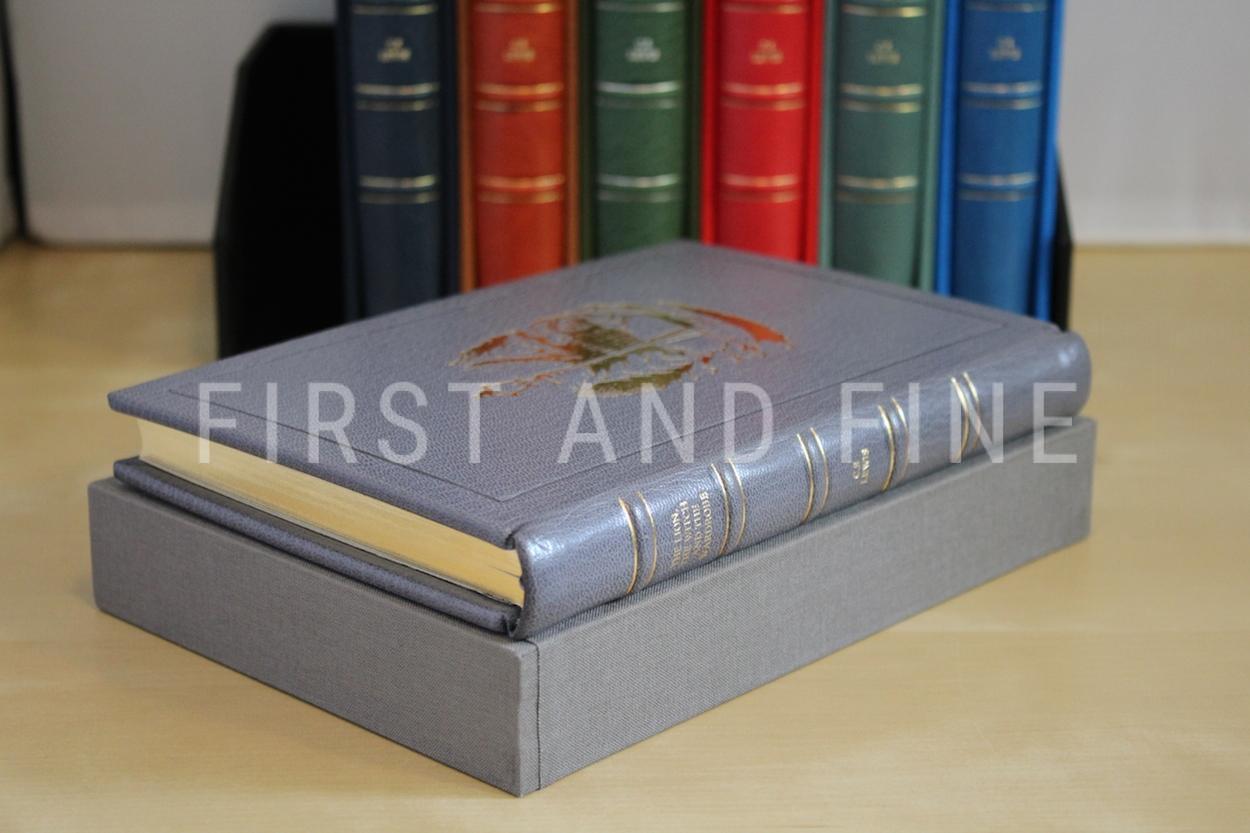
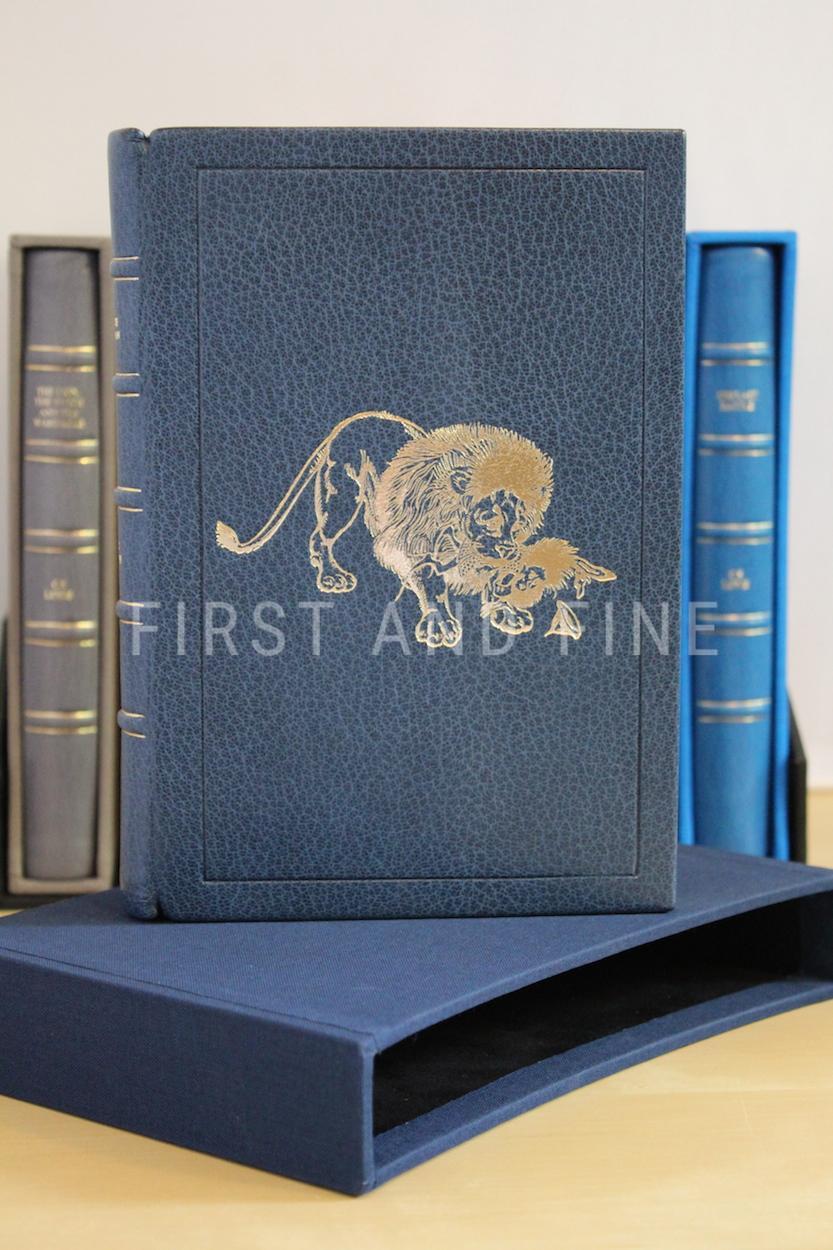
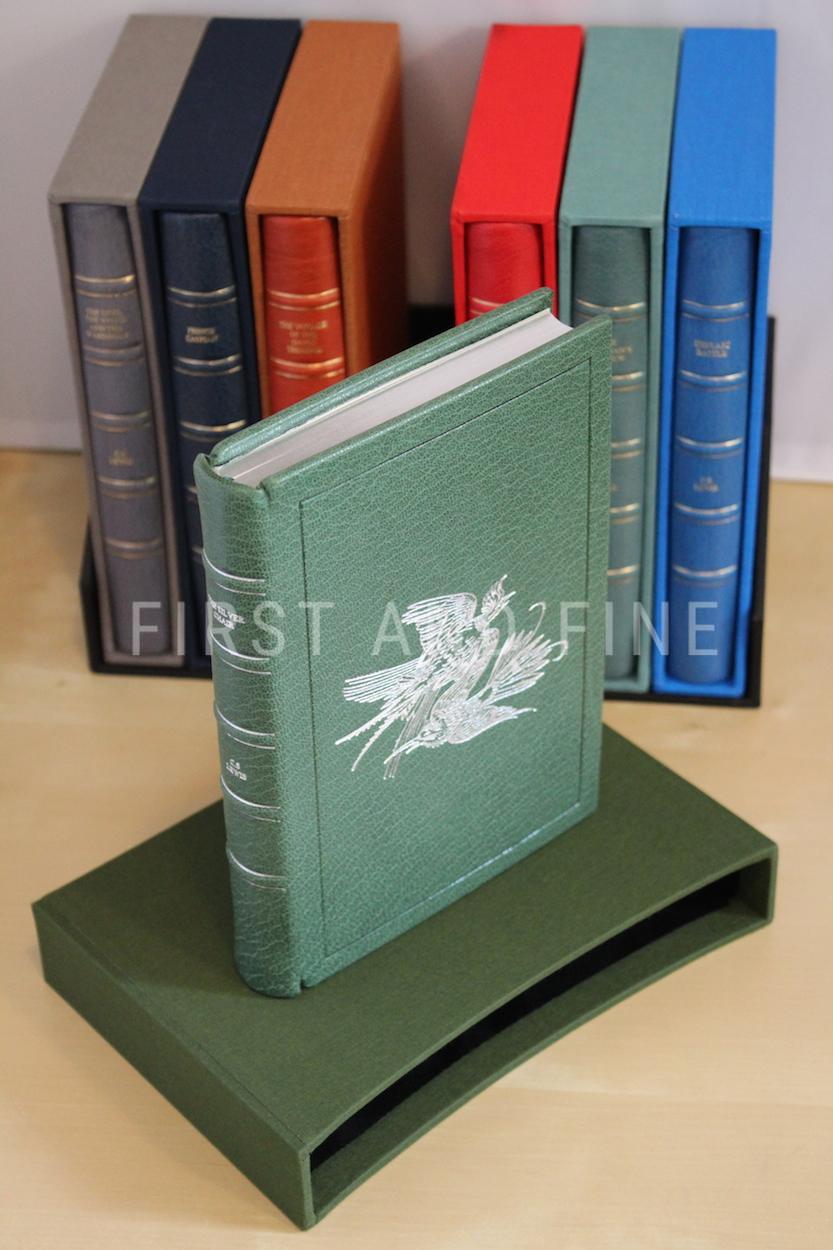
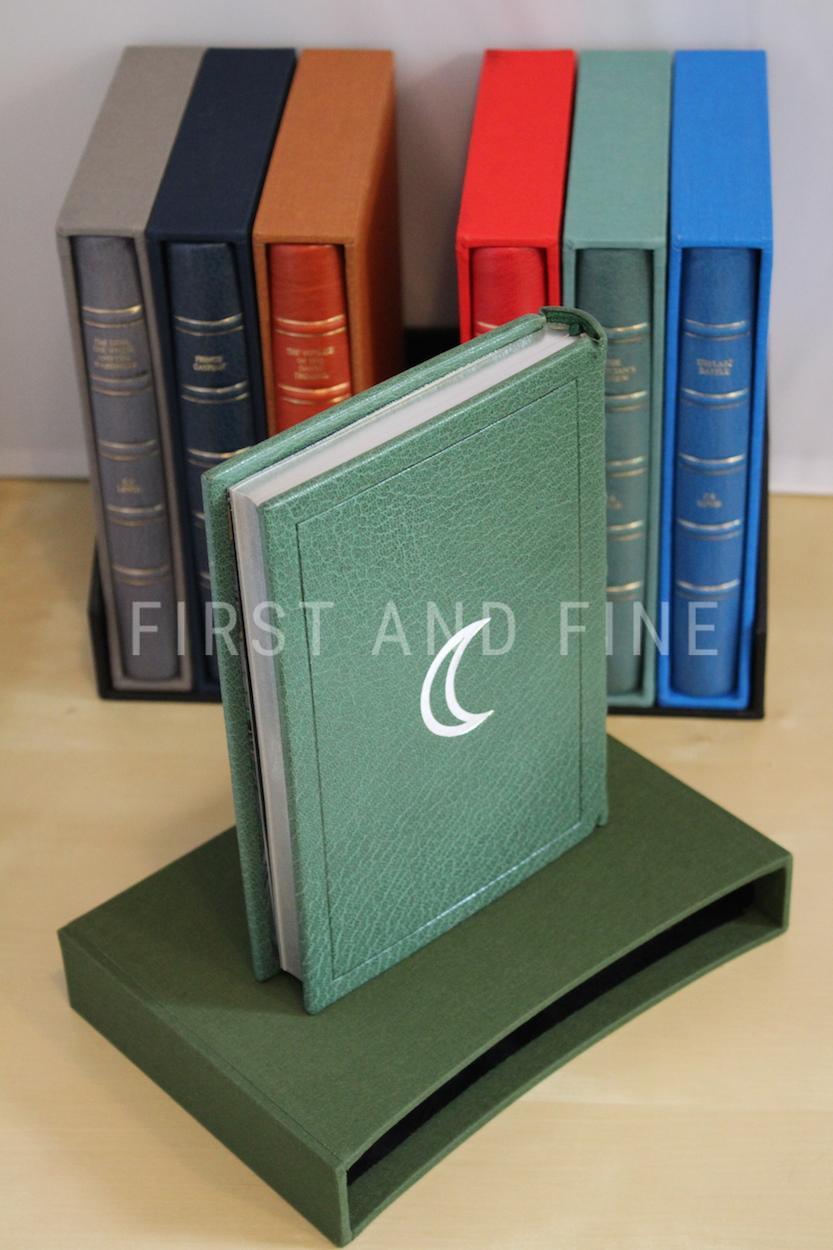
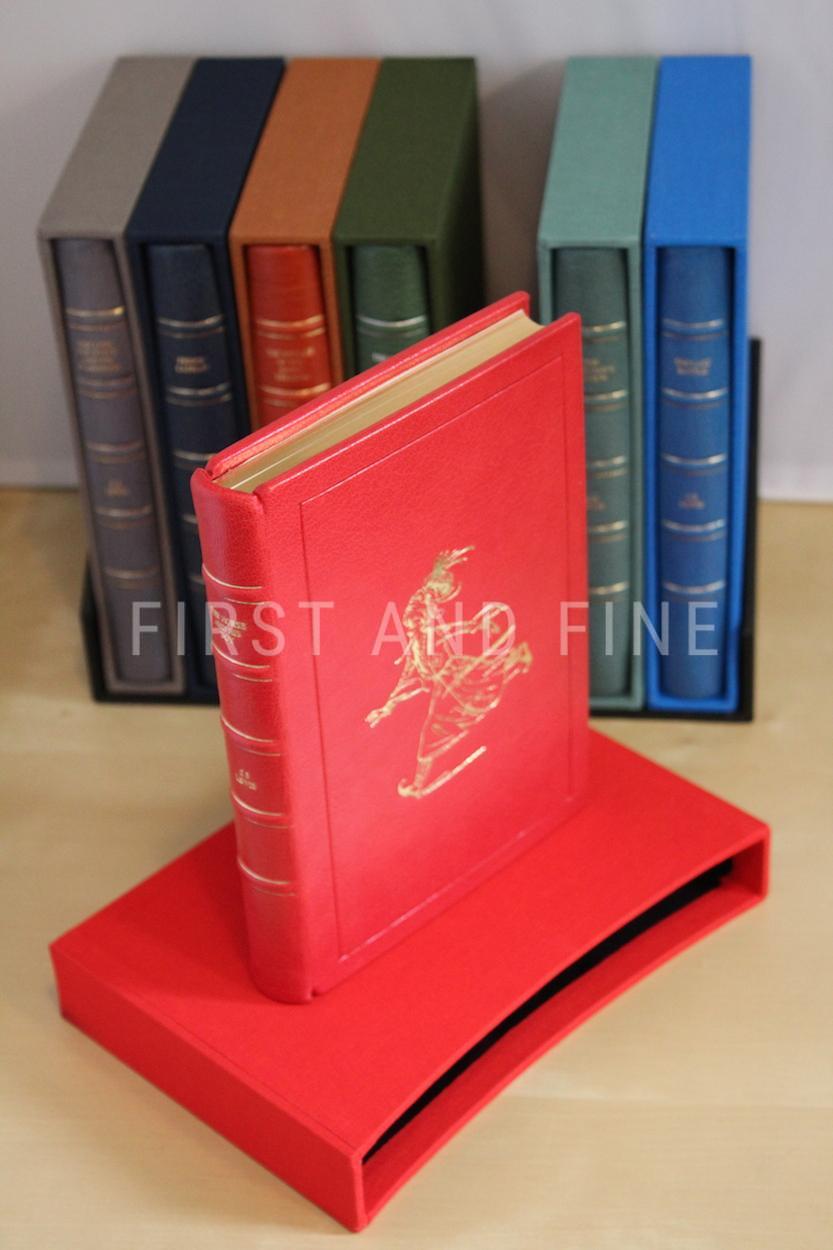
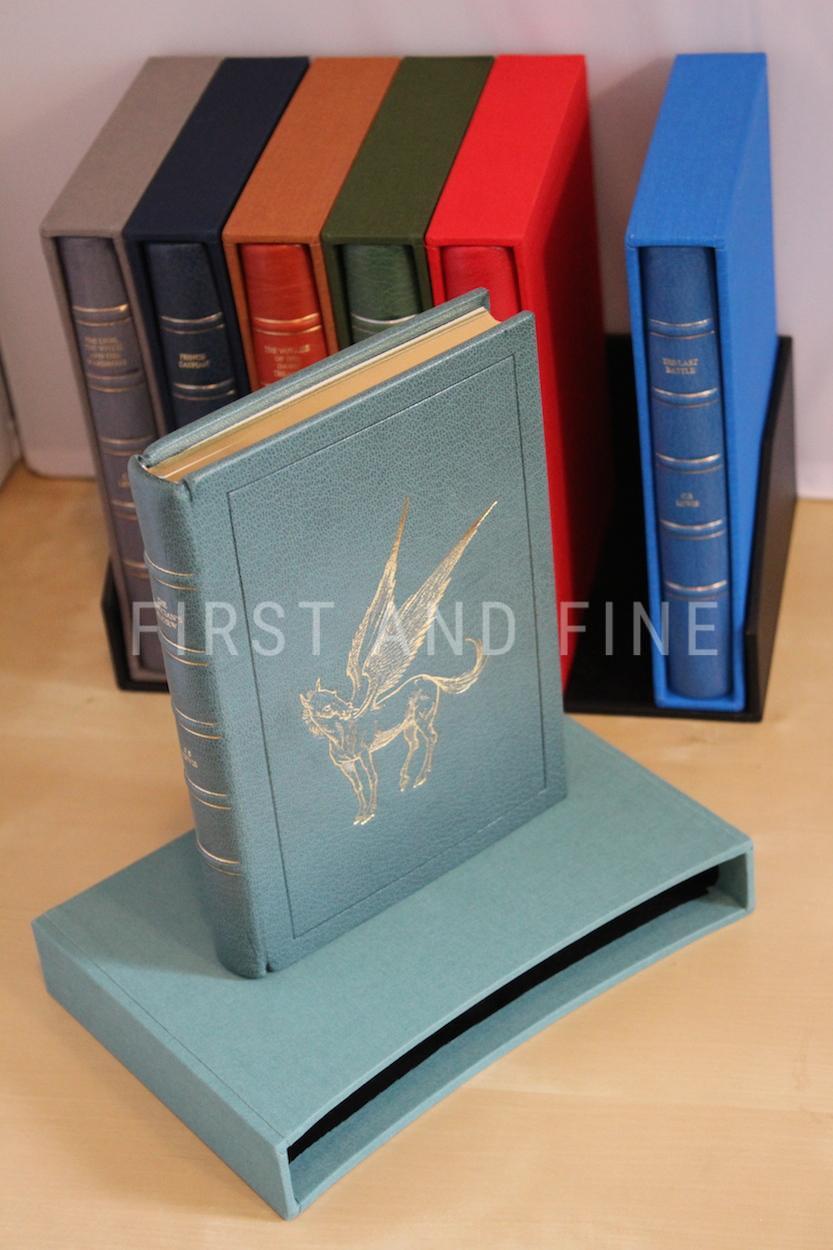
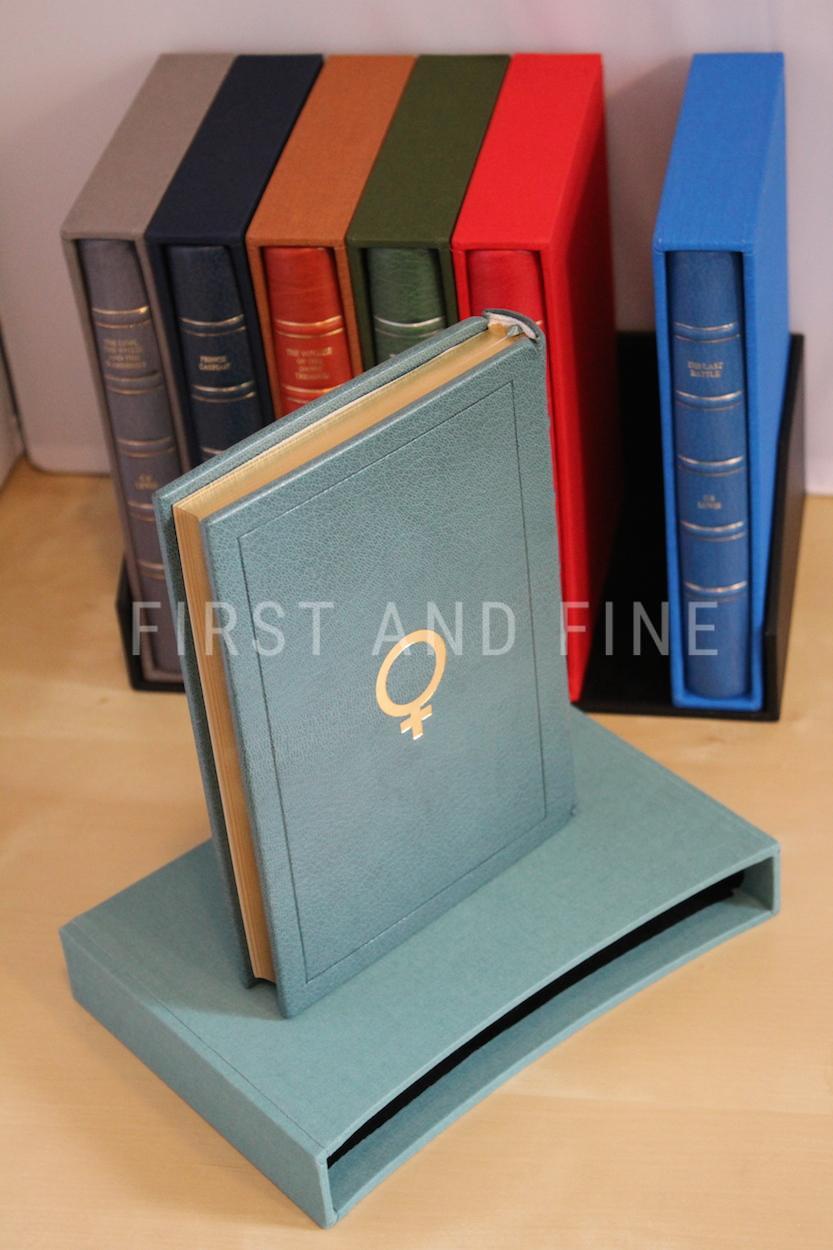
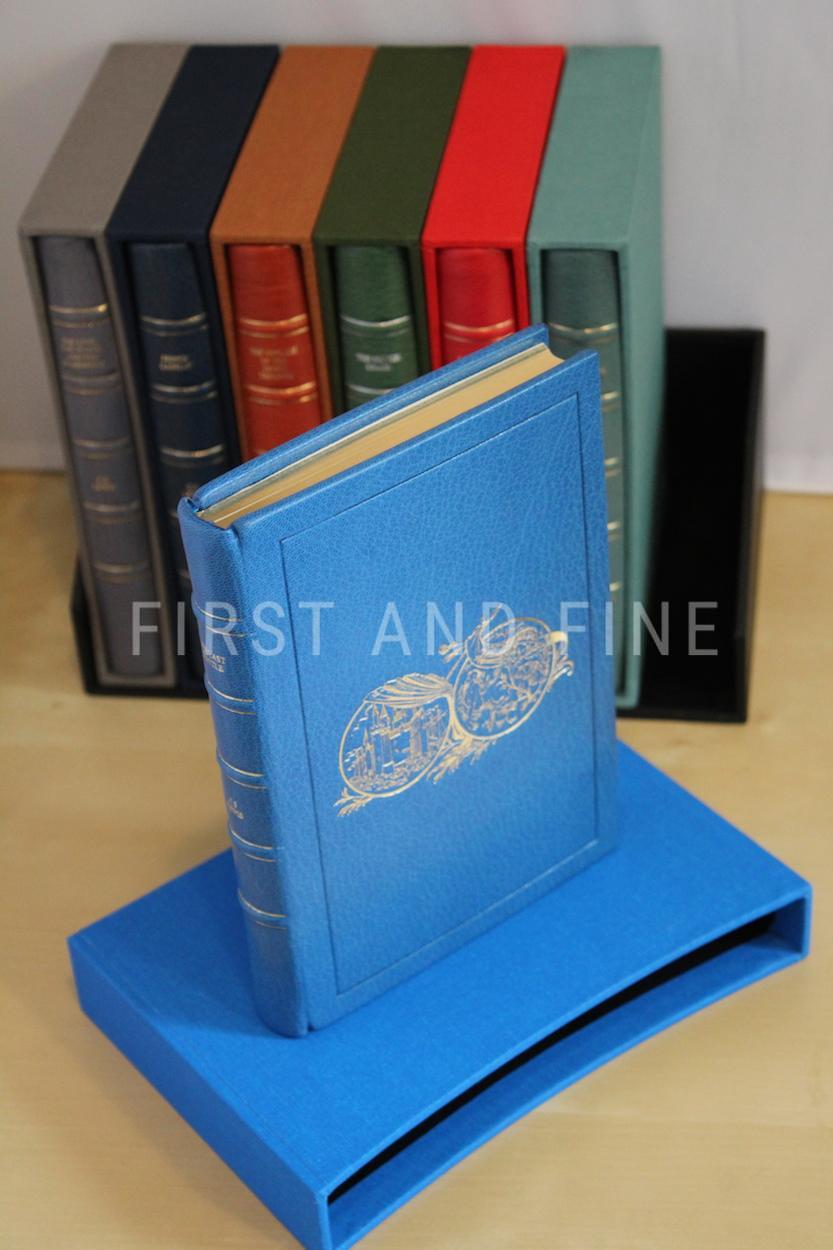
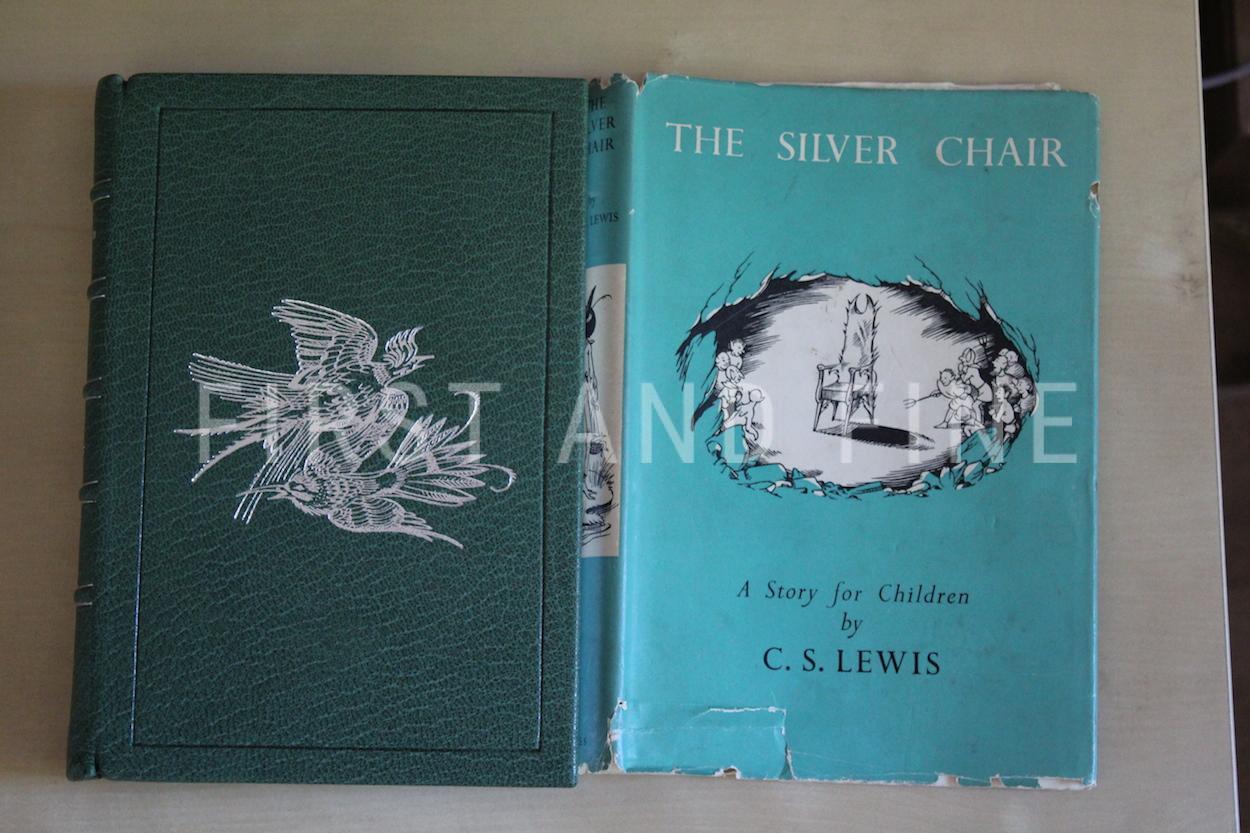
The design of this set marries two ideas. First, the fact that these are books written for children, and second, their planetary symbolism, according to the latest academic research on the Narniad. Every book is bound in a different colour to appeal to the principal target audience of young children. The colours were not chosen randomly, but roughly correspond – and pay homage to – the colours of the first edition dust jackets (please refer to our images to see examples). Hence, ‘The Lion, the Witch and the Wardrobe’ is bound in grey leather; ‘Prince Caspian’ in dark blue; etc. Each front board is stamped in gold with one of Pauline Baynes’ (the original illustrator of the series) own images from inside the corresponding book. (The only exception is ‘The Silver Chair’ which is stamped in silver, as explained below.) For example, ‘The Lion, Witch and the Wardrobe’ shows the famous lamp-post which Lucy sees when she first enters Narnia through the wardrobe (page 14). The back boards show the symbol – in gold except ‘The Silver Chair’ which is stamped in silver – of one of the seven planets of the Middle Ages as understood within the traditional geocentric model of the cosmos. ‘The Lion, the Witch and Wardrobe’ thus shows the symbol for Jupiter; ‘Prince Caspian’ shows Mars; ‘The Voyage of the Dawn Treader’ displays the Sun; ‘The Silver Chair’ the Moon; ‘The Horse and His Boy’ Mercury; ‘The Magician’s Nephew’ depicts Venus; and ‘The Last Battle’ Saturn. According to Professor Michael Ward (2008) in his ground-breaking study ‘Planet Narnia: The Seven Heavens in the Imagination of C.S. Lewis’, Lewis wrote the Narniad to reflect the traits of these seven heavenly bodies, which he described as “spiritual symbols of permanent value”. Lewis was a medievalist who studied the pre-Copernican model of the cosmos closely (e.g. ‘The Discarded Image’, 1964) and who responded to it imaginatively in his poetry (e.g. ‘The Planets’, 1935) and in his ‘Ransom Trilogy’ (1938-45) of inter-planetary adventures. Ward’s best-selling and award-winning book is published by Oxford University Press and has been described by the ‘Times Literary Supplement’, the UK’s premier literary journal, as “something of a masterpiece”.
– All books have been bound in finest goatskin leather, provided by the UK’s leading book leather producer – Harmatan and Oakridge. Only sumac (a flowering plant) and other natural materials are used in the tannage of this fine quality range of leathers. These skins are hand polished and finished to show the beauty of the natural grain. The natural character of each skin is maintained, no pigment finishes are added and no grain correction is made.
– All books have been gilded by hand on all three edges, except in the case of ‘The Silver Chair’, whose edges are in silver to reflect the colour attributed to Luna (the Moon). It is also fitting that the ‘lunatic’ is the odd one out.
– To the spine, five raised bands have been created with gold lines hand tooled either side. The title of each book and the author’s name have been stamped between them.
– Each book has double end-bands and a silk marker ribbon. The spine of each book has then been reinforced and strengthened with paper linings, linen and a made hollow.
– The endpapers (see four examples in our images) were created by master marbler Freya Scott of Paperwilds (UK). The design with the swirls and gold dots reminds us of the night sky and the heavenly bodies’ swirling movements. The endpapers have been divided with leather ‘joints’. This allows the front and back boards to open fully without putting strain on the first and last pages of the book. The original map endpapers were painstakingly removed from the original covers over a period of days, and finally re-attached to the marbled papers to create a ‘made endpaper’ on four of the seven books (only four of the seven first editions of the Chronicles have map endpapers).
– Each book comes in its own bespoke slipcase which are colour coded. These have been lined with black suede and are covered with different coloured book cloths. All slipcases are contained within two larger trays. These trays allow the books to be kept together as one and add a little extra protection to the slipcases. They have, again, been lined with black suede and are covered in archival quality black buckram.”
The letter:
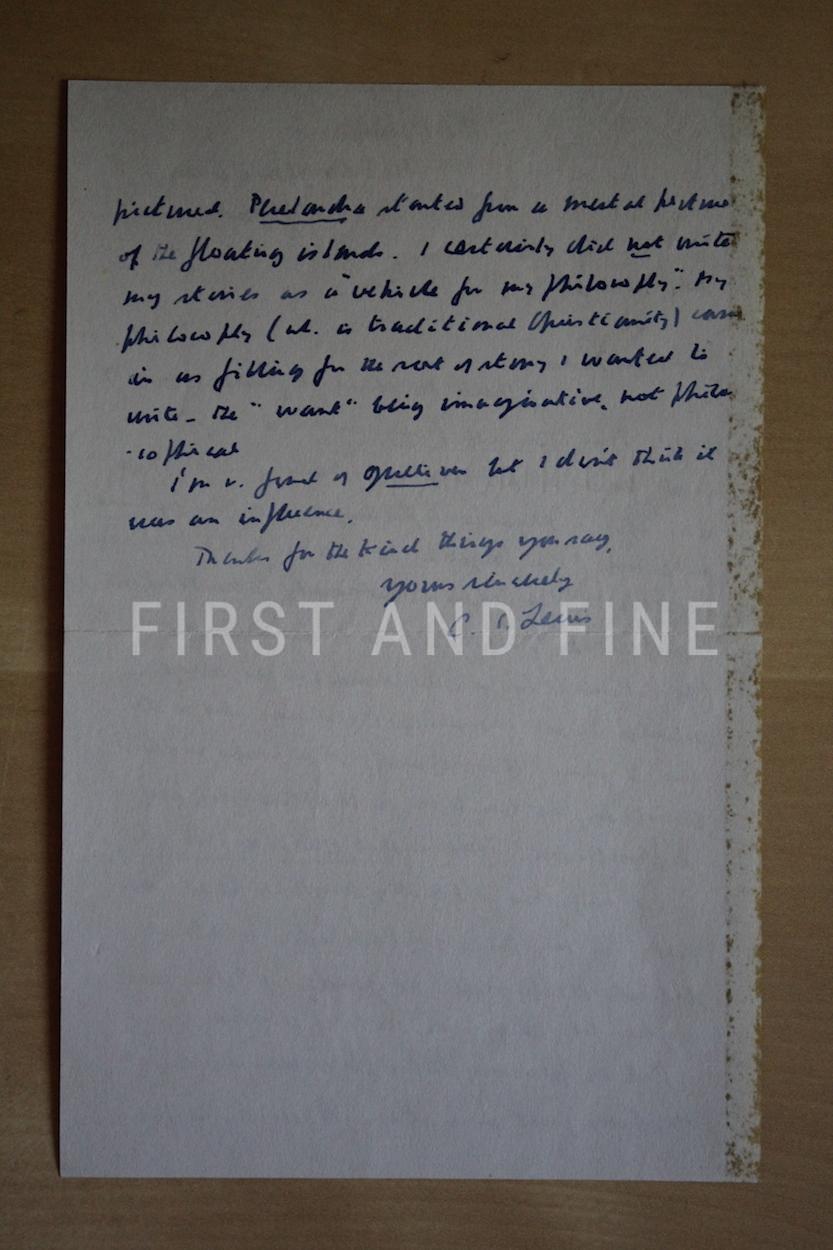
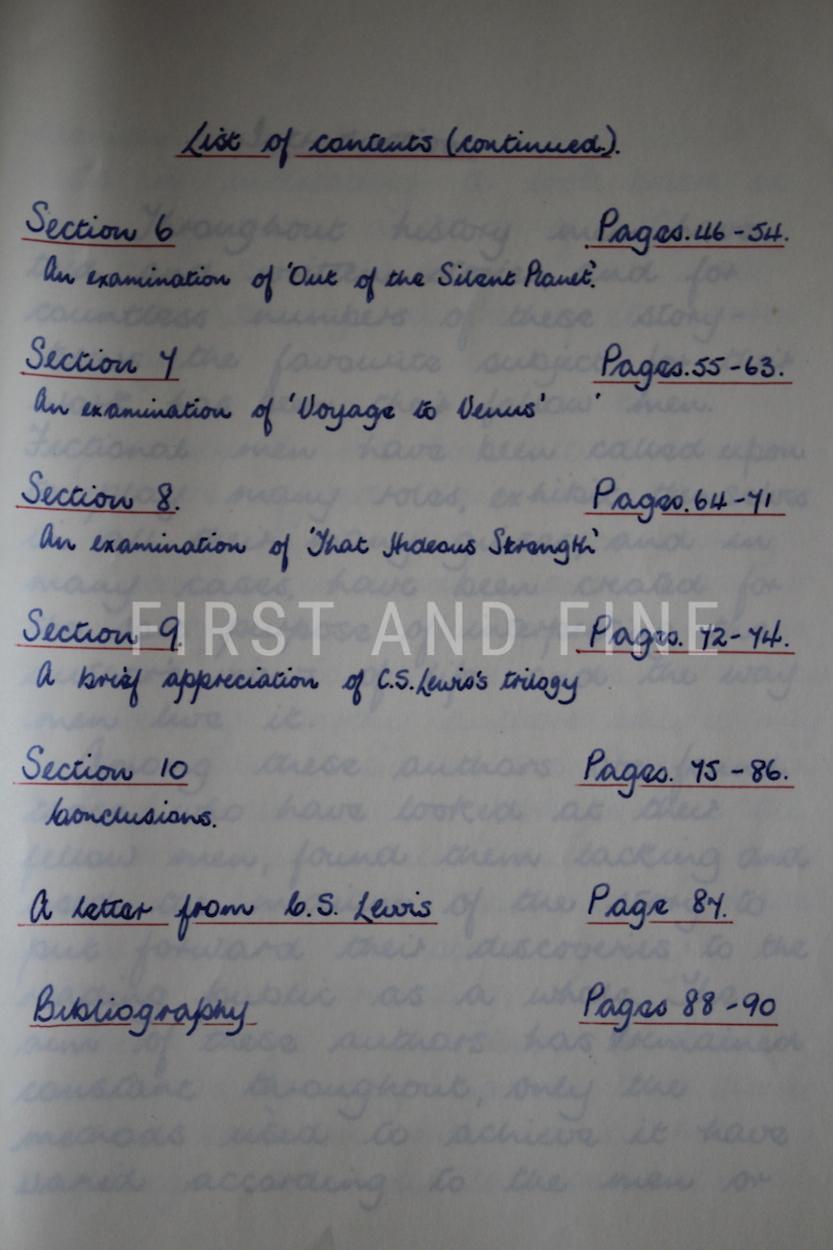
Response to a young Mrs Paddon who researched the topic of ‘underlying comment found in certain works of Jonathan Swift and C.S. Lewis’. Mrs Paddon investigates the Ransom Trilogy (aka The Space Trilogy or The Cosmic Trilogy). The letter, written in the typical small and neat hand, is written over two pages on one sheet light blue watermarked stationary measuring 4.5″ x 7″. In very good condition with one central fold, presumably to fit an envelope. The letter was carefully glued on the margin to the back of the bibliography of Mrs Paddon’s thesis (see our images). The residue is not sticky anymore and only discoloured the paper yellowish. This does not affect the content of the letter nor the signature as shown.
Dated 20 March 1963 and located The Kilns, Headington Quarry, Oxford:
“Dear Mrs. Paddon, I think the chief influence was H.G. Wells’s First Men in the Moon – not as a socialist work but as a specimen of “science-fiction”. There was also a negative influence, a re-action against an essay (I’ve forgotten the title) in J.B.S. Haldane’s Possible Worlds where he seriously takes Weston’s view that the perpetuation of the human species (by colonization of other planets) is an object superior to all morality. There was also a desire to show that science fiction could work on Christian, no less than on materialistic, pre-suppositions. Except in That Hideous Strength I shd. say there is hardly anything about “society” in my trilogy. Perelandra is almost entirely theological – the garden of Eden over again but, this time, the Fall averted. But the primary thing for me was always the story just as a story – especially the things pictured. Perelandra started from a mental picture of the floating islands. I certainly did not write my stories as a “vehicle for my philosophy”. My philosophy (wh. is traditional Christianity) came in as filling for the sort of story I wanted to write – the “want” being imaginative, not philosophical. I’m v. fond of Gulliver but I don’t think it was an influence. Thanks for the kind things you say. Yours sincerely C.S. Lewis”
This is a fascinating letter which reveals some the sources of and influences upon the Ransom Trilogy. Of great interest is the remark that the story comes first and the philosophy and theology fill the story to give extra layers. This is no different in the Chronicles. They can be enjoyed as simple stories by very young children, but when re-read at an older age they reveal more layers and deeper meanings. In the Narniad case so deep, that it took over fifty years (!) to discover the planetary symbolism hidden within them.
A fantastic first edition set rebound most beautifully by one of the best new generation binders working in the UK.
| Weight | 4.9 kg |
|---|
Sold
Out of stock
Related products
-
Rowling, J.K. (1998) ‘Harry Potter and the Chamber of Secrets’, UK signed and inscribed first edition, later print
£1,750.00 -
Atwood, Margaret (1986) ‘The Handmaid’s Tale’, UK signed first edition
£2,000.00 -
Puzo, Mario (2020) ‘The Godfather’, Folio Society illustrated edition with an original artwork/ remarque by the artist
£300.00 -
Pohl, Frederik (1977) ‘Gateway’, UK first edition
£200.00